



Lets be real. Every radio box promises you something like "Up to 30 miles!" But you know that in a city, getting even one good mile can feel like a victory.
Today, were cutting through the marketing noise and talking about why your Motorola, Hytera, or even that super solid Icom unit performs so differently depending on where you use it. The core issue is the environment.
1. The Big Blocker: Line-of-Sight (LOS) is Everything
Radio waves, just like light, travel best in a straight line. Thats why you get that huge advertised range when communicating from one mountaintop to another. The moment something gets in the way, the trouble starts.
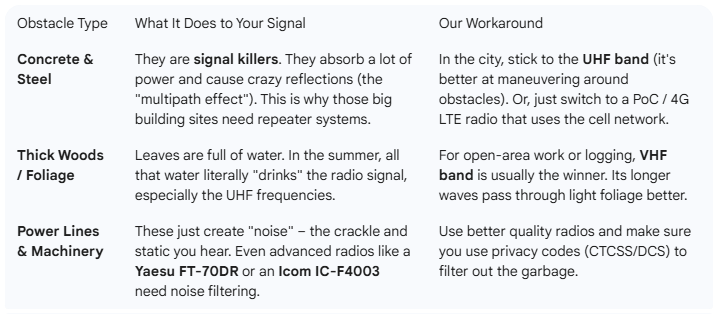
- The Reality Check: Any physical barrier—a building, a hill, or even a patch of dense trees—forces the radio signal to either "bend" (diffraction) or "bounce" (reflection). Every time it has to do that, the signal loses power. So, if youre standing behind a warehouse, your high-powered Hytera PD780 or a Motorola MOTOTRBO unit is going to struggle just as much as a basic unit.
2. The Concrete Jungle & Terrain Torture Test
High-rise buildings, steel structures, and concrete walls are the mortal enemies of clear radio signals.
3. Why Your Frequency Choice is the Real MVP
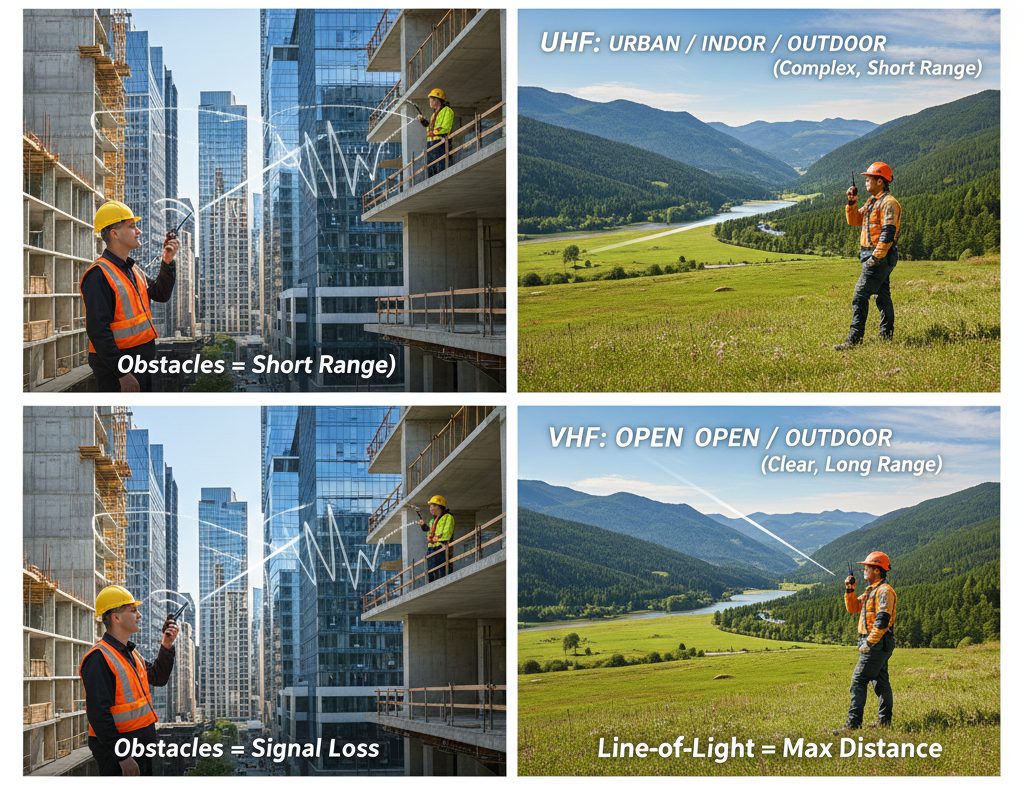
The frequency band is like choosing the right vehicle for the road:
- VHF (Lower Frequency): This is the off-road truck. Its longer waves travel well over rolling terrain and punch through foliage. Great for open fields, marine use (where Icom is a leader), and forests.
- UHF (Higher Frequency): This is the sports car in a parking garage. Its shorter waves are excellent at penetrating light structures and bouncing off walls. Ideal for multi-story buildings, industrial sites, and dense cities—which is why the Motorola TRBO line often focuses on UHF for enterprise.
If you have a powerful radio but are using the wrong frequency for your environment, youre setting yourself up for disappointment.
Final Takeaway: Stop Looking at the Box!
Choosing a radio isnt about picking the biggest brand name. You need to focus on where you primarily operate:
- Mostly Outdoors/Rural/Forests: Go with a VHF setup.
- Mostly Indoors/Urban/Multi-story: Go with UHF or look seriously at PTT over Cellular (PoC) systems for seamless indoor/outdoor handoff.
Effective radio communication is a blend of smart technology and understanding physics. Dont let the distance numbers on the box fool you!


